
How to Choose the Right Laser for Automotive VIN Deep Marking
In automotive VIN laser deep marking applications, the four key factors that determine equipment selection are the workpiece material (steel, aluminum, or mixed steel/aluminum), production cycle time, marking depth, and consumable durability. The physical characteristics of different metals directly affect laser compatibility, while production speed and cost requirements require the right laser configuration. In this guide, we explain the selection logic for VIN laser marking systems based on steel and aluminum characteristics and real production scenarios to help you choose the most suitable solution.
1. Understand the Material: Steel vs. Aluminum
Steel and aluminum are the two most common materials used in automotive frames and components. Their physical properties are significantly different, making material selection the foundation of laser selection.
Steel Characteristics
High laser absorption efficiency
Low thermal conductivity
Melting point: approximately 1,500°C
Vaporization point: approximately 2,800°C
Deep marking on steel requires instant vaporization of molten metal while preventing excessive burrs or raised edges. A laser with sufficient pulse energy is preferred to consistently achieve a marking depth of 0.25 mm or greater.
Aluminum Characteristics
High reflectivity
High thermal conductivity
Melting point: approximately 600°C
Vaporization point: approximately 2,500°C
Deep marking aluminum requires not only high laser power but also high power density and high frequency to overcome rapid heat dissipation and strong reflectivity, ensuring a stable marking depth of at least 0.25 mm.
2. Laser Selection for Different Production Scenarios
Scenario 1: Mixed Steel and Aluminum Production Line
For flexible production of both steel and aluminum parts, choose according to production cycle requirements.
Fast Production Cycle (≤20 seconds)
Recommended: CW 1500W Continuous Wave Laser
Suitable for high-speed marking on both steel and aluminum, meeting the requirements of high-throughput production lines.
No Strict Cycle Time Requirement (Around 45 seconds)
Recommended: MOPA 300W Laser
Provides excellent durability, meets national VIN depth standards, reduces operating costs, and offers longer protective lens life.
Scenario 2: Steel Production Line
Select according to production speed, marking depth, and protective lens durability.
Fast Cycle (≤25 seconds, Depth ≥0.25 mm)
Recommended: QCW 150W Laser
With pulse energy up to 15J, it instantly vaporizes molten steel and produces clean markings with minimal burr formation.
Ultra-Fast Cycle (≤15 seconds, Depth ≥0.25 mm)
Recommended: CW 1500W Continuous Wave Laser
The ideal solution for extremely high-speed automotive production lines.
No Cycle Pressure (25–45 seconds)
Recommended: MOPA 300W Laser
Offers significantly longer protective lens life and lower maintenance requirements when production speed is not the primary concern.
Scenario 3: Aluminum Production Line
Recommended: MOPA 300W Laser
This is the preferred solution for aluminum due to its high reflectivity and thermal conductivity.
The 300W MOPA laser provides adjustable frequency with peak power up to 100 kW. Its combination of high power density and high frequency quickly overcomes aluminum's physical characteristics, achieving marking depths above 0.25 mm within a production cycle of less than 20 seconds.
3. Protective Lens Durability
Protective lens lifetime directly affects maintenance costs and production downtime.
QCW 150W / CW 1500W
Generate relatively large sparks during marking. Typical protective lens life ranges from 1,000 to 5,000 parts, depending on steel material, marking depth, and VIN code length.MOPA 300W
Offers significantly longer protective lens life. In some applications, no protective lens is required. Typical service life exceeds 3,000 parts.
4. Easy-to-Understand Working Principle
The differences between laser types can be understood with a simple analogy.
CW / QCW Laser
Like using a large shovel, each strike removes more material with greater force, creating clean and deep markings without excessive burrs. Ideal for deep marking on steel.MOPA Laser
Like using a smaller shovel, each strike removes less material, but operates at a much higher frequency. It is especially suitable for highly reflective materials such as aluminum, although slight edge burrs may appear due to its marking characteristics.
5. Quick Selection Guide
Production Scenario
Cycle Time
Recommended Laser
Main Advantage
Steel & Aluminum Mixed Line | ≤20 s | CW 1500W | High-speed compatibility for both materials |
Steel & Aluminum Mixed Line | ~45 s | MOPA 300W | Long lens life and lower maintenance cost |
Steel Parts | ≤25 s | QCW 150W | High pulse energy with clean deep marking |
Steel Parts | ≤15 s | CW 1500W | Maximum production speed |
Steel Parts | ~45 s | MOPA 300W | Protective lens life exceeding 3,000 parts |
Aluminum Parts | ≤20 s | MOPA 300W | Optimized for highly reflective aluminum |
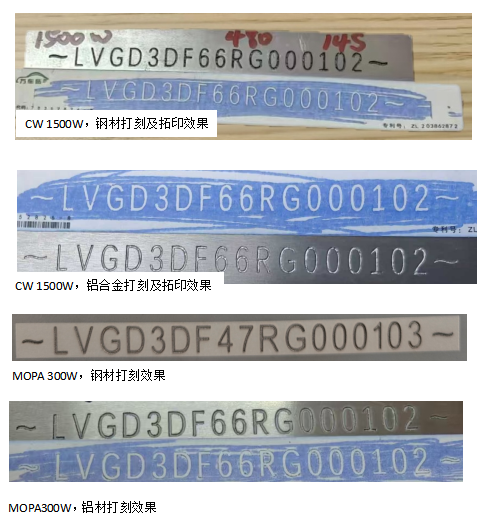
6. Comparison of Marking Results
7. Customer Application Cases
There is no universally "best" laser for automotive VIN deep marking—only the solution that best matches your material and production requirements.
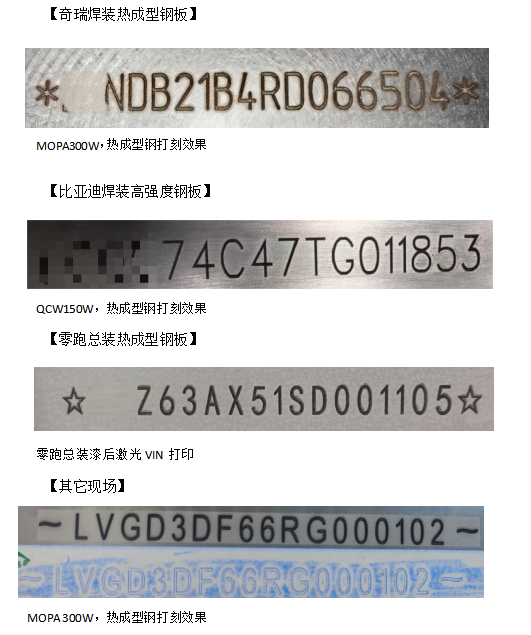
With nearly 30 years of experience in automotive manufacturing and component marking, we provide complete VIN marking solutions ranging from manual workstations to fully automated robotic systems. Our solutions can be integrated with 3D vision guidance, 3D laser depth measurement, OCR verification, and laser inspection technologies, enabling fully automated processes from VIN marking to quality inspection while ensuring compliance with national marking depth standards and traceability requirements.
To date, we have delivered more than 250 VIN deep marking systems equipped with QCW 150W, MOPA 200W/250W/300W, and CW 1500W lasers. Our customers include leading global EV manufacturers as well as BYD, Geely, NIO, Li Auto, XPENG, Leapmotor, BAIC, Volkswagen, BMW Brilliance, and many other automotive manufacturers. According to incomplete statistics, vehicles produced using our VIN laser marking systems have exceeded 25 million units worldwide.
If you need one-on-one consultation or sample testing, please contact us for a customized VIN laser marking solution tailored to your production requirements.
If you're interested in any of the equipment mentioned in this article, feel free to contact our sales engineers for detailed product information and customized technical solutions.

